Every Room Has One Wall
Worth Framing.
- Feature walls
- Framed wall panels
- Wainscoting boxes
- Headboard walls
- Hallway panelling
- Dining-room surrounds
- Picture-frame inserts
- Stair & landing walls
- Fireplace & TV walls
- Entrance-hall panels
Wall-frame moulding with a bold finish inside it is the cheapest expensive-looking thing you can do to a room. We fill the frame with architectural film — oak, marble, linen or a deep solid — applied to the wall in situ, wipe-clean, and warrantied in writing.
One wall. No demolition. Up to 70% less than replacing a surface.
The finish goes onto the wall itself, in situ.
Architectural film is applied to the wall you already have — to flat plaster, to a fitted panel, to the recessed face inside a moulded frame — with nothing torn out and nothing sent to the rubbish dump. One continuous finish can run the full height of a feature wall, or a single framed insert can carry it inside the moulding while the rest of the room stays painted.
In the embossed ranges the texture is in the film itself: timber grain, the surface of a honed stone, the weave of a linen — there under your hand as well as in the eye. It is the latest generation of surface technology from the world's leading film brands, and it is exactly why these finishes are judged by hand rather than from a photograph.
And every panel is named. The manufacturer's own reference for the film you chose appears against each element on your written, itemised quote, again on your invoice, and again on the roll label opened in the room on install day. The warranty documents — the manufacturer's cover against cracking, peeling and fade for up to 10 years, with our workmanship cover alongside — are in your hand at completion.
Four ways to turn a plain wall into the best thing in the room.
All four are the same idea told differently: keep the moulding and the outer wall quiet, and put the material inside the frame.
The Accent Frame
Put the boldest finish inside the moulding and nowhere else. A deep-toned or strongly textured film panel fills the framed section — behind the sofa, behind the television console, behind the bed — while the outer wall and the moulding itself stay crisp and neutral. The frame does the containing; the film does the talking. One wall's worth of material, and the room reads as though it was designed around it.
The Two-Tone Frame
Two shades, one wall. The outer frame stays a soft neutral — a beige, an off-white, a pale grey — and the recessed inner panel takes the deeper, warmer partner: a caramel-toned timber grain, a honed stone, a fine linen weave. Because the inner panel is film and the outer wall can stay painted, you are pairing a finish against a colour rather than matching two tins. The contrast is settled from a sample held against the wall it will live on.
The Film Insert
Where wallpaper would go, put film instead. A patterned or textured film panel sits inside a plain picture-frame moulding and gives you the same decorative moment — with one difference that matters in a hallway or behind a dining table: it is wipe-clean with a damp cloth and a mild household cleaner, and it carries its manufacturer's written warranty. Edges and returns are wrapped rather than trimmed short, which is exactly where cheaper work gives itself away.
Wainscoting, Warmed Up
Classic box moulding on the lower wall, and something richer inside each box. A warm oak, a deep solid, a woven textile effect — carried across every box so the run reads as one piece rather than a row of squares — with the upper wall kept light so the panelling grounds the room instead of closing it in. It is the treatment that makes a dining room or a hallway feel built rather than decorated.
The rooms where one framed wall does the most work.
Living Rooms
The focal point behind the sofa, or the wall the television hangs on — the one surface every seat in the room already faces.
Dining Rooms
Classic elegance around the table, in a finish that wipes clean exactly where chair backs and hands actually reach it.
Hallways & Landings
A narrow corridor with nothing in it reads as leftover space. Framed panelling gives it a reason to exist.
Bedrooms
Frame the headboard wall and the bed reads as part of the architecture, rather than furniture pushed against plaster.
Entrance Halls
The first surface a guest reads, and the one that sets what they expect from the rest of the house.
Studies & Home Offices
The wall behind you on every call — a framed panel of oak, stone or linen instead of a blank one.
A wall is the one surface with room for a strong finish.
Veining rewards scale. A marble with a strong vein that would arrive busy across a run of small cupboard doors is exactly right on a wall, where the eye has room to follow it from one side of the panel to the other. The reverse holds too: quieter stones, honed concretes and terrazzo sit more comfortably when a wall is broken into many small wainscoting boxes.
Direction is a decision on tall panels. Timber grain, brushed metal and linen weave all read differently depending on which way they run. Vertical grain lengthens a panel and makes a wall feel taller and more architectural; horizontal calms it and pulls the eye across. It is the same film either way — the decision is purely how you want the wall to read, and we agree it panel by panel on the walk-round, before anything is cut.
Light decides the rest. The same oak is warmer at four in the afternoon than it was at nine in the morning, and a matte and a satin can be near-impossible to tell apart until a lamp goes on. So we bring the film brands’ sample books to you and you judge the shortlist against your own wall, in the light that wall actually gets. The visit is designed to end with the choice settled.
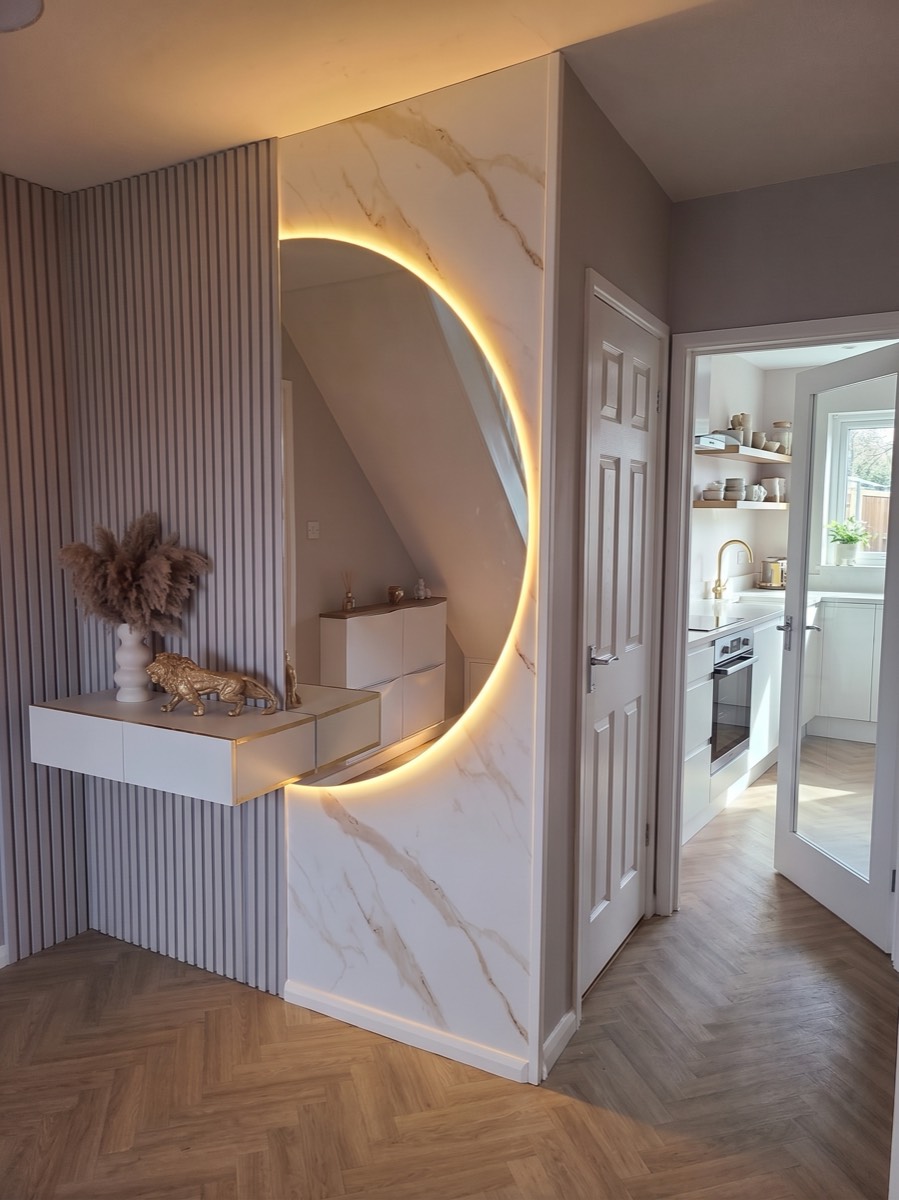
Oak inside the frame, or marble across the whole wall.
Over 1,500 architectural film finishes from Cover Styl’, Bodaq, 3M DI-NOC and LX Hausys — browsed here, or held against your own wall at the measure-up.
What people ask about panelled walls.
Can you wrap over existing painted panelling?
Usually, yes — on sound, flat, well-adhered surfaces. Film bonds to what is underneath it, so the preparation decides how long the wall lives: surfaces are cleaned, degreased and made good first. Where paint is flaking, a panel is soft or a moulding has worked loose, we tell you at the survey — before you spend, not after. That honest counsel is part of what the measure-up visit is for.
Do you supply and fit the moulding as well?
The wrapping is ours; new moulding is fitted by trusted partners we work with. Where the moulding is already on your wall, we wrap the panels inside it. Where it is still to be built, we arrange the carpentry through our partners and programme the two as one job — frames up, preparation done, film on. Tell us at the survey which of the two you are, and the plan comes back to you in writing.
Can one wall be wrapped and the rest of the room left painted?
Yes — that is exactly the accent logic, and film and paint pair well. The framed panel takes the finish that carries the texture and the pattern; the surrounding wall and the moulding stay in a flat neutral. You wrap only the surface that earns it, which is why a feature wall is one of the least expensive ways to change how a whole room reads. Wrapping is typically up to 70% less than replacing the same surface, and here you are treating one wall rather than four.
How do I choose between a wood, a stone and a textile finish for a wall?
Start from what the room is short of. Wood grains bring warmth and are the family most people recognise first. Stone and marble effects bring calm and reward a generous, uninterrupted panel, where the veining has room to run. Textile and linen effects give a headboard or a dining wall softness while staying wipe-clean, which upholstery cannot be. Then judge a short handful as real samples against your own wall, in your own light — our guide to choosing a finish walks through it properly.
Will it damage the wall or the paint if it comes off one day?
It is a bonded finish, specified surface by surface — so the honest answer depends on what is underneath, and you get it at the survey rather than as a blanket promise here. We look at the substrate, the paint and the condition of each wall, then tell you the honest expectation for those surfaces; where a wall should not be wrapped at all, we say so before you spend. What is guaranteed goes in writing: the manufacturer's warranty against cracking, peeling and fade for up to 10 years, handed over at completion with our workmanship cover alongside.
See it on your
own surfaces.
Send a few details and we’ll arrange a visit to measure the wall, the frames and the panels, and hold the film brands’ sample books against your own light — then prepare an itemised estimate naming the film against each panel.
Wrapt Interiors™ works across Johannesburg and Gauteng, and nationwide by arrangement.