Cover Styl’, Bodaq, 3M DI-NOC and LX Hausys:
The Four Film Brands, Compared.
Four film brands account for the whole of the library we specify from, and clients reasonably want to know what separates them before they are shown a swatch. This page sets that out from the catalogue itself.
There is no ranking here and there is no best. All four manufacture self-adhesive architectural film for interior surfaces, and a single scheme often draws from more than one of them. What differs is the size of the range, the families each one is strongest in, and what each publishes against a reference.
The short answer.
All four film brands manufacture self-adhesive architectural film for interior surfaces; what separates them in our catalogue is the size of the range, the material families each is strongest in, the warranty published against a reference, and whether any of the range is rated for exterior use.
The four film brands as our published catalogue records them. Counts are rounded down and grow as the catalogue does.
| What you are weighing | Cover Styl’ | Bodaq | 3M DI-NOC | LX Hausys |
|---|---|---|---|---|
| References published | Over 500 | Over 120 | Over 180 | Over 700 |
| Strongest families | Wood, solid colour, metal, marble and stone, textile, concrete, leather — the broadest spread of the four. | Wood, solid colour, marble, metal. | Wood, metal, concrete, stone and rust/patina — the strongest industrial and metal spread. | Wood and solid colour above all, then metal, concrete and textile. |
| Warranty recorded against a reference | Five to ten years depending on the reference; most of the range is recorded at ten. | Five years across the published range. | Not published against the reference in our catalogue — the manufacturer’s data sheet is available on request. | Not published against the reference in our catalogue — the manufacturer’s data sheet is available on request. |
| Rated for interior and exterior | Eleven references — the Exterior Collection, coded EXT-. | None in our published catalogue; the range is interior. | Seventeen references, coded with an EX suffix. | Six references, published as the Outdoor series. |
| Textures published on the reference | The widest: soft, structured, textured, small-grained, soft matte, soft touch, matte, rustic, anti-fingerprint, metallic, gloss and high gloss. | Matte, textured, smooth and metallic. | Matte, gloss and high gloss. | Soft touch. |
| Also in the range | The High Resistance collection — twelve references the manufacturer engineers for high-traffic surfaces, at ten years. | A compact, deliberately edited range rather than a deep one. | Heavy representation in metals, concretes and oxidised finishes. | The deepest wood and solid-colour banks of the four. |
Every figure here is read from our own published catalogue, not from a film brand’s marketing. A blank warranty means the manufacturer does not publish a term against that reference in the data we hold — it is not a statement that no cover exists, and the data sheet is available on request.
One reference from each film brand.
A wood, a marble, a matte walnut and a soft-touch solid — one from each of the four ranges, pulled live from the catalogue.
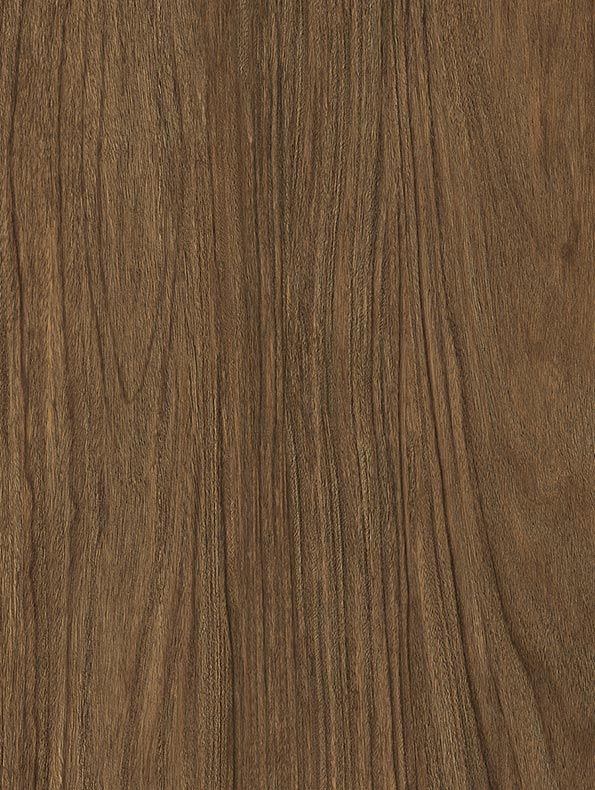

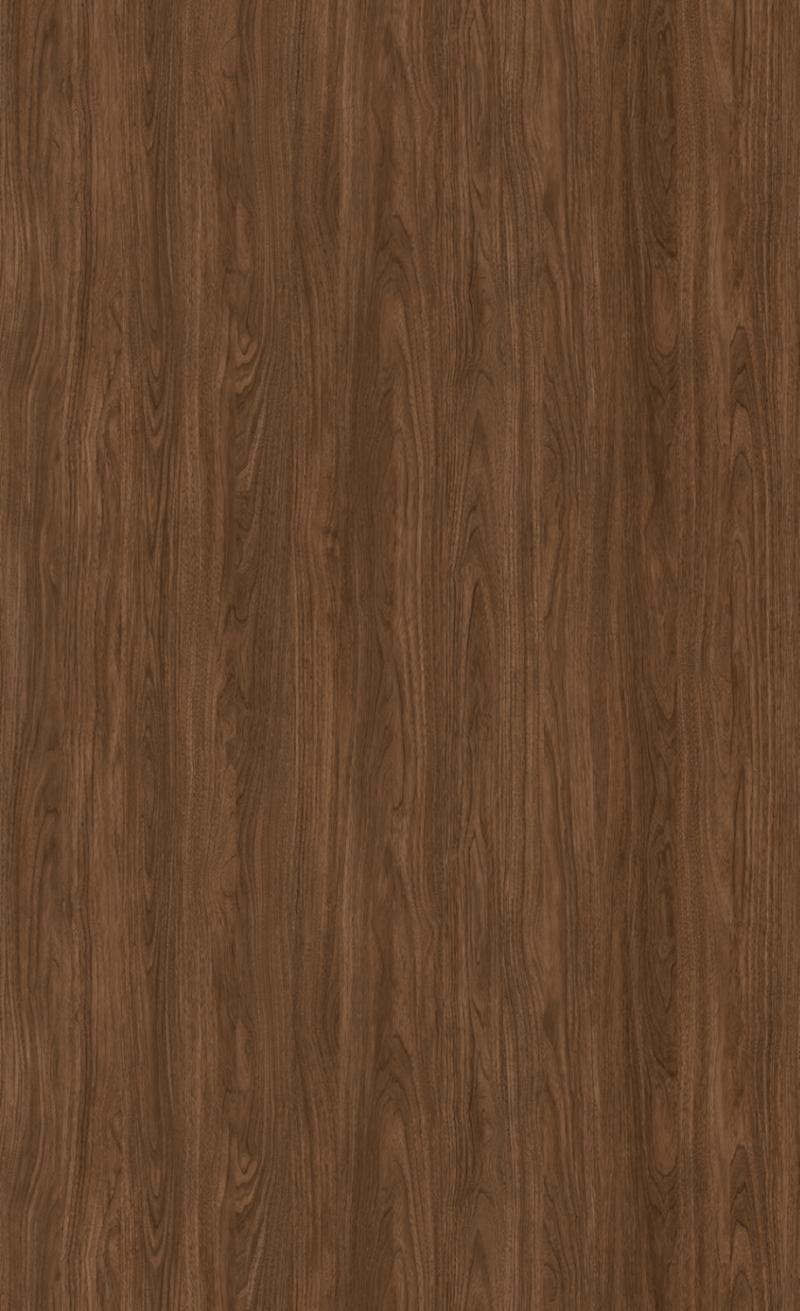

Over 1,500 references are published across these four film brands. The brand is rarely what a client chooses — the finish is, and then the reference decides whose film it is.
Why the range sizes differ so much.
A range with seven hundred references is not a better film than a range with a hundred and twenty. It is a bigger palette, and the two facts are worth separating before the numbers do any persuading.
Depth in one family. Most of the difference between the biggest and the smallest range here is depth in wood and solid colour: a brand with hundreds of oaks is giving you more shades of one decision, not a different class of product.
Breadth across families. The more useful question for a scheme is how many families a brand covers, because a project that has to hold joinery, doors, panelling and a counter in one palette is served by breadth rather than depth.
Edited versus exhaustive. A compact range is an editorial decision as much as a manufacturing one. It is genuinely easier to choose from, which matters more than it sounds when a client is looking at their fortieth oak.
What the warranty column can and cannot tell you.
Two of the four manufacturers publish a warranty term against each reference in the data we hold, and two do not. That is a difference in what is published, and it is worth being precise about what it means.
Where a term is published, we pass it through: the manufacturer’s own warranty against cracking, peeling and fade is stated in writing on your quote, and our workmanship cover is written alongside it. Interior films across the library are warranted for up to 10 years.
Where a term is not published against the reference, we do not invent one. The manufacturer’s data sheet is available on request, and where a project needs the published specification for an element or an environment we quote the data sheet rather than paraphrase it. A blank in that column is an honest blank, not a silence.
How the film brand gets chosen — last.
Almost nobody arrives wanting a brand. They arrive wanting a colour, a grain, a stone or a feeling in a room, and the brand is simply whoever manufactures the reference that answers it.
The finish leads. We start from the look, the sheen and the element, narrow to a handful of references, and the brand follows from that. A scheme drawing from two film brands is completely ordinary.
The duty narrows it. A worktop, a lift interior or an outdoor element narrows the field before taste does, because only some ranges are engineered or rated for those. That is a specification decision, made at the survey.
The reference is what is committed. Whatever the brand, what goes on the quote is the reference — and that is what is checked against the roll label on install day and ordered again years later for a repair.
How to check which film you are actually being sold.
The single most useful thing on a wrapping quote is the film brand’s own reference named against each element. It is the reference that ties the quote, the invoice and the roll label together, and it is the reference that makes a repair possible years later.
A quote that names only “vinyl by the metre” has not told you which of these four ranges — if any — is going onto your surfaces, and it leaves nothing to check on install day or to match against afterwards. Ask for the reference. Anyone working to a specification can supply it without hesitation.
You can also check it here: search the library by reference, open the finish page, and read the brand, the family, the texture, where it is rated to go and the warranty recorded against it.
What people ask about the film brands.
Which architectural film brand is best?
There is no best, and we would be doing you a disservice by naming one. All four film brands we install — Cover Styl’, Bodaq, 3M DI-NOC and LX Hausys — manufacture self-adhesive architectural film for interior surfaces, and the right one for your project is whoever makes the reference that answers the look, the element and the duty. What genuinely differs between them is the size of the range, the material families each is strongest in, what each publishes against a reference, and which ranges carry an exterior rating. Those differences are set out factually on this page so you can weigh them yourself rather than take an adjective from us.
How many finishes does Wrapt Interiors™ carry?
Over 1,500 references are published in our library across the four film brands, and every one of them has its own page carrying the brand, the material family, the texture, the colour family, where the manufacturer rates it to be installed and the warranty recorded against it. The spread is heaviest in wood and solid colour, with deep banks of metal, concrete, marble and stone, textile and leather. You can filter the whole library by any of those facts, shortlist what survives, and put up to four side by side in the comparison tool before your surveyor brings the film brands’ sample books to the measure-up visit.
Do all architectural films carry the same warranty?
No, and the honest position is that not every manufacturer publishes a term against every reference. In our catalogue, Cover Styl’ references are recorded at five to ten years depending on the reference with most of the range at ten, and Bodaq at five; for 3M DI-NOC and LX Hausys no term is published against the reference in the data we hold, and the manufacturer’s data sheet is available on request. Where a manufacturer does publish a warranty we pass it through and state it in writing on your quote, with our workmanship cover written alongside it. Where one is not published we do not invent a number to fill the gap.
Can one job use films from more than one brand?
Yes, and it is common. The finish is chosen element by element rather than bought as a set, so a kitchen might take a wood grain from one brand on the doors and a stone look from another on the island end, and a commercial fit-out might draw a metal from one range and a textile from a second. What keeps that manageable is the paperwork: each element is measured and quoted individually with the exact reference named against it, whoever makes it. That is what goes on the invoice, what is checked against the roll label on install day, and what gets ordered again if one element ever has to be redone.
Compare the four yourself.
One reference from each brand, opened in the comparison tool — family, texture, colour, where each can go and the warranty recorded against it, in one table.
Nothing here is a hold, a booking or a price. Your surveyor brings the film brands’ sample books to the visit, and you can change your mind at any step — including on install day, before the film goes on.
See it on your
own surfaces.
Tell us the surfaces and the look. We measure element by element, bring the film brands’ sample books to you, and issue a written, itemised quote naming the exact film reference against each element, with preparation included in the price.
The call-out fee is credited back when you go ahead, the deposit is tied to a confirmed install date, and the balance falls due on completion after your own inspection.
Wrapt Interiors™ installs across Johannesburg and Gauteng, and nationwide by arrangement. Call +27 74 906 5616 or email hello@wraptinteriors.co.za.